
Written by Filibert Patrick F. Tad-awan, PhD | Photo: University of the Cordilleras
Reinforcing its commitment to academic collaboration, responsible public safety education, and sustainable peacebuilding, the University of Baguio (UB), through the School of Criminal Justice and Public Safety (SCJPS), participated in the Peace, Justice and Security Consortium Meeting and the Learning Forum on Professional Policing held on August 18, 2026, at the University of the Cordilleras (UC) Main Campus. UB was represented by Dr. Filibert Patrick F. Tad-awan and Mr. Justin Almarvez.
The Peace, Justice and Security Consortium Meeting convened representatives of member institutions to identify strategic priorities and develop collaborative initiatives in areas of shared academic and societal significance. Central to the meeting were discussions on academic and research collaboration, strategic priorities, and the formulation of a consortium roadmap for future programs and activities. These agenda items underscored the value of inter-institutional cooperation in advancing education, research, and community-responsive initiatives in peace, justice, and security.
The official program further provided a structured platform for consortium members to examine the direction of the partnership, identify priority areas, discuss opportunities for academic and research collaboration, and formulate a roadmap to guide succeeding consortium undertakings. Participation in the meeting contributes to strengthening institutional linkages and creating opportunities for joint research, faculty and student engagement, knowledge exchange, professional development, and collaborative community initiatives in areas relevant to criminal justice, forensic science, public safety, peacebuilding, and security governance.
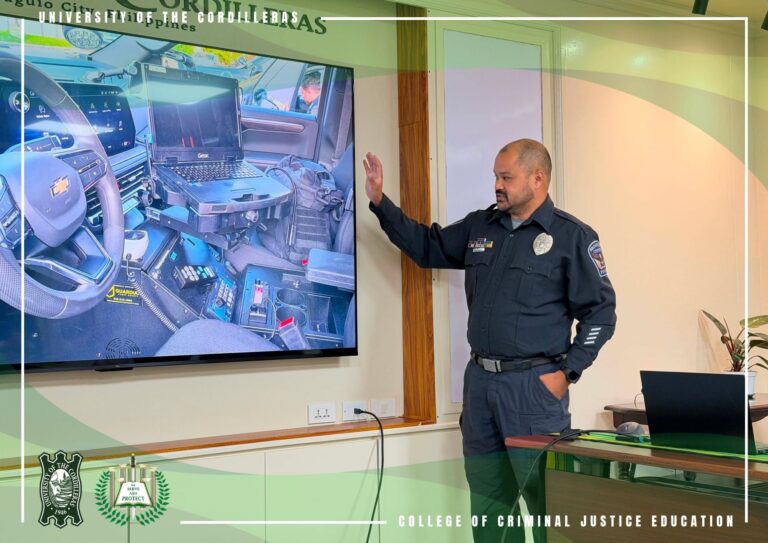
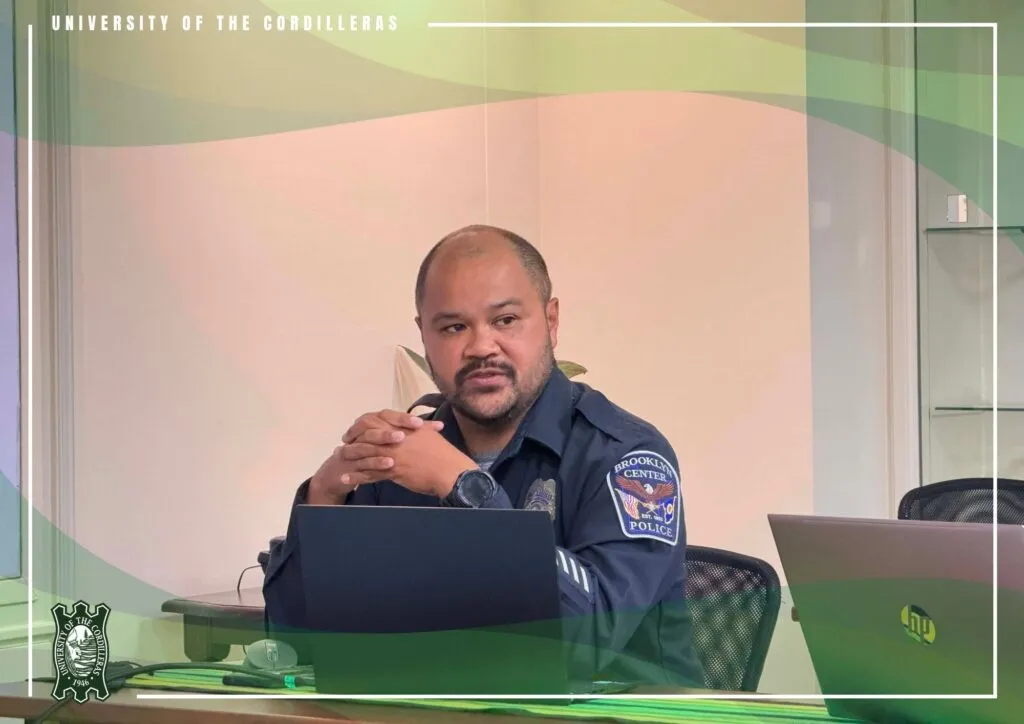
Complementing the consortium meeting was the Learning Forum on Professional Policing, themed “The Force Continuum: A Rights-Based Approach to Policing.” The forum featured Officer Allan E. Salvosa of the Brooklyn Center Police Department, Minnesota, USA, who shared professional perspectives and experiences concerning rights-based policing, the lawful and proportionate use of force, and contemporary law-enforcement practices.
The international dimension of the learning forum provided participants with an opportunity to engage with contemporary policing perspectives beyond the Philippine context while examining their relevance to criminal justice and public safety education. Discussions on proportionality, human rights, accountability, and professional policing are particularly significant in preparing future criminal justice and public safety practitioners to balance legitimate law-enforcement objectives with the protection of individual rights and human dignity.
Advancing the Sustainable Development Goals through Education and Partnership
The University of Baguio’s participation in the Peace, Justice and Security Consortium Meeting and the Learning Forum on Professional Policing underscores its commitment to advancing the United Nations Sustainable Development Goals (SDGs), particularly SDG 16 – Peace, Justice and Strong Institutions; SDG 4 – Quality Education; and SDG 17 – Partnerships for the Goals.
The initiative primarily aligns with SDG 16 – Peace, Justice and Strong Institutions, particularly Target 16.6, which emphasizes the development of effective, accountable, and transparent institutions. The learning forum, themed “The Force Continuum: A Rights-Based Approach to Policing,” highlighted the importance of lawful and proportionate use of force, respect for human rights, accountability, and professional law-enforcement practices. These discussions contribute to promoting institutional awareness of responsible policing and strengthening the academic foundations of ethical and rights-based public safety practices. The activity is likewise relevant to Target 16.3 on promoting the rule of law and Target 16.a on strengthening institutional capacities through cooperation and knowledge exchange.
The activity also supports SDG 4 – Quality Education, particularly Target 4.7, which promotes education for sustainable development, human rights, a culture of peace and non-violence, and responsible citizenship. Through exposure to contemporary and internationally informed policing perspectives, the learning forum provided opportunities for professional learning, critical reflection, and the exchange of knowledge relevant to criminal justice and public safety education. The consortium further creates opportunities for collaborative research, faculty development, curriculum enrichment, and academic engagement that may contribute to improving the quality and relevance of higher education.
Equally significant is the initiative’s alignment with SDG 17 – Partnerships for the Goals, particularly Target 17.16, which emphasizes partnerships that mobilize and share knowledge, expertise, and resources. The Peace, Justice and Security Consortium provides a collaborative platform through which participating higher education institutions can identify shared priorities, develop coordinated initiatives, and establish a roadmap for future academic, research, and community-oriented programs. Such cooperation strengthens institutional networks and creates opportunities to address complex challenges in peacebuilding, justice, security governance, and public safety through collective expertise and sustained engagement.
Through its participation, UB-SCJPS reinforces the role of higher education institutions as partners in advancing quality education, responsible public safety practices, institutional accountability, and sustainable development. The initiative demonstrates how academic collaboration and professional knowledge exchange can provide a foundation for future programs that contribute to safer, more inclusive, just, and peaceful communities.
Building Sustainable Academic and Professional Partnerships
The participation of Dr. Filibert Patrick F. Tad-awan and Mr. Justin Almarvez represents UB-SCJPS’s active engagement in strengthening networks that connect higher education, research, professional practice, and community-oriented public safety initiatives. Such partnerships provide important avenues for developing collaborative research, sharing institutional expertise, benchmarking emerging practices, and designing programs responsive to contemporary challenges in justice and security.
More importantly, participation in the consortium advances a partnership model in which higher education institutions serve not only as centers of instruction but also as knowledge partners in peacebuilding, justice, security governance, and sustainable development. Through sustained collaboration with academic institutions, professional organizations, practitioners, and development partners, universities can translate research and education into initiatives with broader institutional and societal value.
The activity consequently strengthens the University of Baguio’s continuing pursuit of quality education, research engagement, responsible citizenship, institutional collaboration, and community service. By participating in platforms that promote rights-based policing and cooperative approaches to peace and security, UB-SCJPS continues to expand opportunities for its faculty and students to engage with evolving professional standards and interdisciplinary perspectives.
Moving forward, the Peace, Justice and Security Consortium provides a promising platform for sustained inter-university research, capacity-building activities, academic exchanges, professional forums, and collaborative community engagements. For the University of Baguio, these partnerships reinforce the role of higher education in developing competent and socially responsible professionals while contributing to safer, more just, resilient, and peaceful communities