
Written by: Dr. Filibert Patrick F. Tad-awan, Mr. Justin Joseph T. Almarvez, and Ms. Faith Pae R. Javier
On October 1, 2026, the University of Baguio, through faculty representatives from the School of Criminal Justice and Public Safety (SCJPS), participated in the opening day of the C.U.B.E. ARISE 2026: Asian Research and Innovation for Sustainable Education Congress at the University of Baguio Gymnasium. Representing SCJPS were Dr. Filibert Patrick F. Tad-awan, Mr. Justin Joseph T. Almarvez, and Ms. Faith Pae R. Javier. The two-day congress, scheduled from October 1 to 2, aimed to strengthen research cooperation, promote sustainable educational innovation, and connect academic work with the needs of institutions and communities.
Guided by the theme “Building Resilient and Humanitarian Learning Communities through Research and Sustainable Innovations,” the congress addressed educational and social challenges through four research tracks: Humanitarian Resilience and Learning Communities; Sustainable Innovation and Educational Transformation; Partnerships, Peace, and Inclusive Development in Education; and Gender and Development. The activity encouraged participants to translate research into responsive teaching practices, institutional programs, public policies, and community-based solutions.
The University of Baguio served as the host institution, while the C.U.B.E. Management Exchange consortium and its partner institutions supported the academic gathering. The congress was co-hosted by Ateneo de Naga University, Quezon City University, University of Saint Anthony, Manuel S. Enverga University Foundation, Luther University, and O.P. Jindal Global University. Their participation represented an in-kind contribution of professional expertise, institutional networks, research knowledge, and academic resources; no corresponding monetary value was reported. The opening program included registration and distribution of conference materials, a doxology, the Philippine National Anthem, a cultural presentation, welcome and inspirational messages from institutional leaders, and a ceremonial ribbon-cutting. University of Baguio President Dr. Javier Herminio D. Bautista welcomed the participants and emphasized the role of higher education in research, innovation, collaboration, and sustainable development. The formal opening established a shared direction for two days of scholarly exchange.
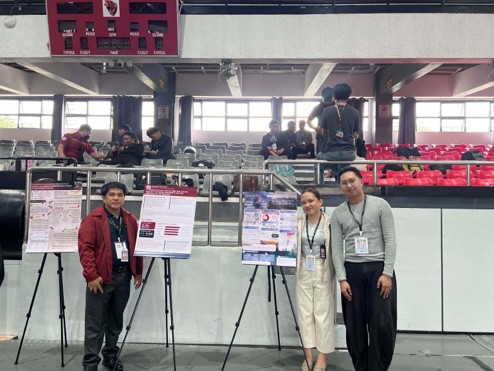
Dr. Filibert Patrick F. Tad-awan, Ms. Faith Pae R. Javier, and Mr. Justin Joseph T. Almarvez of UB SCJPS pose beside research poster presentations during C.U.B.E. ARISE 2026 on October 1, 2026, at the University of Baguio Gymnasium. Photo courtesy of the UB SCJPS Faculty Delegation.
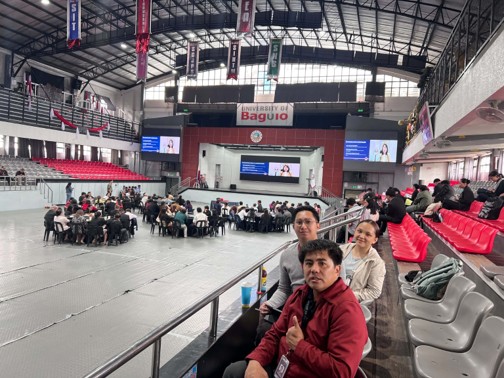
Dr. Filibert Patrick F. Tad-awan, Mr. Justin Joseph T. Almarvez, and Ms. Faith Pae R. Javier represent the University of Baguio School of Criminal Justice and Public Safety during the opening day of C.U.B.E. ARISE 2026 on October 1, 2026. Photo courtesy of the UB SCJPS Faculty Delegation.
Exploring Innovative Perspectives on Educational Practices
Through keynote and plenary presentations, the congress exposed participants to research-based perspectives, emerging educational practices, and sustainable innovations. The discussions emphasized that research should extend beyond publication and contribute to improved instruction, institutional decision-making, community programs, responsible policy, and the quality of life of the people served.
For the SCJPS faculty representatives, the congress provided an opportunity to relate sustainable education and research innovation to criminal justice, forensic science, and public safety instruction. The discussions were relevant to research-informed teaching, evidence-based decision-making, ethical professional formation, disaster and humanitarian response, human security, gender responsiveness, community engagement, and interdisciplinary collaboration. Immediate outputs included the participation of three SCJPS faculty members in a two-day congress, engagement with four major research tracks, exposure to keynote and plenary discussions, and potential research connections with participating institutions. The immediate benefit was the opportunity to examine contemporary studies and identify concepts for instruction, research, extension, and institutional planning. In the long term, the knowledge and networks developed are expected to support collaborative studies, improved classroom practices, and community-responsive SCJPS initiatives.
Championing Sustainable Development Goals Through Research and Innovation
The congress advances Sustainable Development Goal (SDG) Target 4.7 by promoting the knowledge, values, and competencies needed for sustainable development, global citizenship, human rights, peace, and cultural understanding. It also supports SDG Target 9.5 by encouraging scientific research, faculty development, and educational innovation. At the activity level, the two-day program, four research tracks, and participation of faculty and institutional partners served as measurable components of professional learning and research exchange.
The activity further supports SDG Target 16.6 by strengthening the capacity of educators who prepare future professionals for criminal justice, forensic science, and public safety institutions. Research-informed instruction, ethical formation, and evidence-based decision-making contribute to effective, accountable, and trustworthy institutions. Although the congress did not directly measure public satisfaction under SDG Indicator 16.6.2, the competencies developed are relevant to improving the quality and integrity of future public service.
The collaboration also advances SDG Target 17.17 by promoting effective institutional and academic partnerships. Cooperation among the four C.U.B.E. Management Exchange institutions, six co-host universities, invited experts, educators, and researchers demonstrated how shared knowledge and networks can support sustainable educational development. No financial valuation of these partnership contributions was reported.
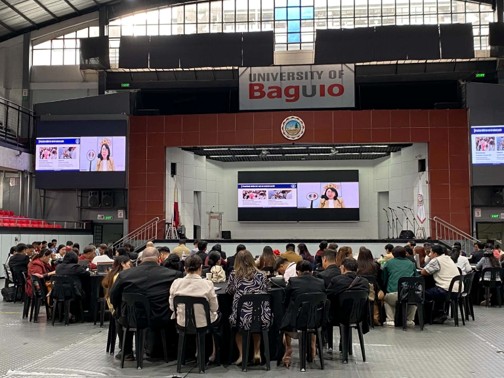
Participants attend a plenary presentation on research, learning communities, and sustainable education during C.U.B.E. ARISE 2026 on October 1, 2026, at the University of Baguio Gymnasium. Photo courtesy of the UB SCJPS Faculty Delegation.
Participation in the congress aligns with the University of Baguio’s Vision, Mission, and Objectives by supporting balanced quality education, academic excellence, relevant social engagement, ethical values, research innovation, and continuous professional development. It also strengthens the University’s commitment to preparing globally competent and socially responsible professionals who can respond to local and global challenges through knowledge, integrity, and purposeful service.
Through C.U.B.E. ARISE 2026, the University of Baguio School of Criminal Justice and Public Safety reaffirmed that research becomes most meaningful when it improves education, informs decisions, strengthens institutions, and benefits communities. The participation of its faculty representatives reflected the School’s continuing commitment to research-informed instruction and to preparing future practitioners who can serve society competently, ethically, and compassionately.