
The University of Baguio’s 2025 institutional report for Sustainable Development Goal 5 (Gender Equality) provides comprehensive metrics regarding student enrollment, degree program entry, and first-generation higher education participation. Grounded in official university reporting, this assessment examines gender distribution across the general student population, details entry rates for female degree seekers, and evaluates the specific proportion of first-generation women commencing higher education.
Assessment of higher education access at the University of Baguio demonstrates strong female representation across general institutional enrollment. Establishing total enrollment figures provides essential context for evaluating specialized indicators such as degree commencement rates and first-generation college access.
As documented in the university’s SDG 5 metrics for 2025, female students constitute the majority of the overall student body. Out of a total population of 19,577 enrolled students, 11,881 are female, representing 60.7% of total enrollment. Male students total 7,696, accounting for the remaining 39.3%.
| Enrollment Benchmark | Male Students | Female Students | Total Cohort | Female Share (%) | Male Share (%) |
| Total University Enrollment | 7,696 | 11,881 | 19,577 | 60.7% | 39.3% |
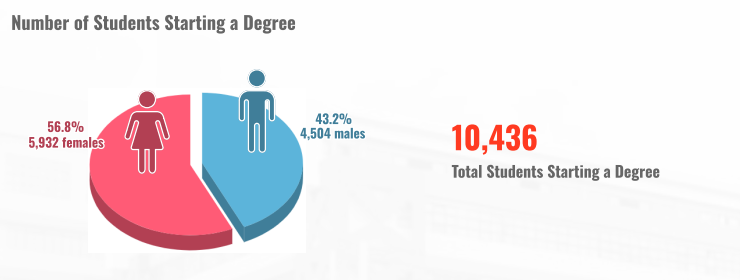
| Students Starting a Degree | 4,504 | 5,932 | 10,436 | 56.8% | 43.2% |
Tracking incoming cohorts at program entry illustrates how gender representation operates at the point of tertiary matriculation. While female representation remains predominant among new degree seekers, comparing incoming degree entrants with total institutional enrollment reveals consistent female participation across academic entry points.
During the 2025 reporting period, a total of 10,436 students commenced a degree program at the University of Baguio. Among these incoming degree seekers, 5,932 are women, accounting for 56.8% of new degree starters. Male students entering degree programs number 4,504, representing 43.2% of the incoming intake.
First-generation higher education access measures the participation of students whose parents or guardians have not completed a tertiary degree. Under SDG 5 guidelines, monitoring first-generation enrollment serves as a critical indicator of socioeconomic mobility and institutional inclusivity.
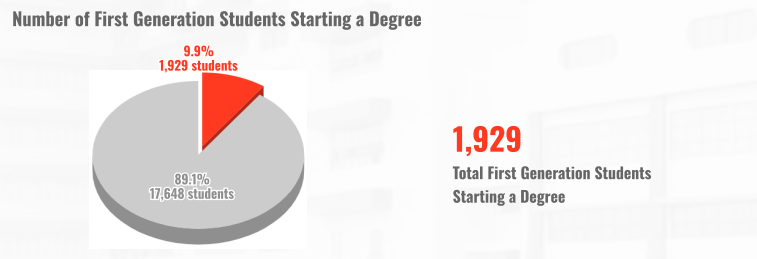
According to the university’s metrics, 1,929 students entering degree programs were identified as first-generation college attendees. This group represents 9.9% of the university headcount benchmark, while non-first-generation degree starters and general cohort comparisons comprise 17,648 students (89.1%).
Evaluating the intersection of gender and first-generation status offers insight into how institutional access programs support women from non-tertiary family backgrounds.
Among the 1,929 first-generation students starting a degree at the University of Baguio, female students make up the majority. Specifically, 1,089 first-generation women commenced a degree program during the 2025 reporting period, representing 56.5% of all first-generation degree starters. First-generation male students total 840, comprising 43.5% of the first-generation intake.
| First-Generation Subgroup | Student Count | Share of First-Gen Starters (%) | Share of Total Female Starters (%) | Share of Total Degree Intake (%) |
| First-Generation Women Starting a Degree | 1,089 | 56.5% | 18.4% | 10.4% |
| First-Generation Men Starting a Degree | 840 | 43.5% | — | 8.0% |
| Total First-Generation Degree Starters | 1,929 | 100.0% | — | 18.5% |
Key statistical indicators for first-generation female students include:
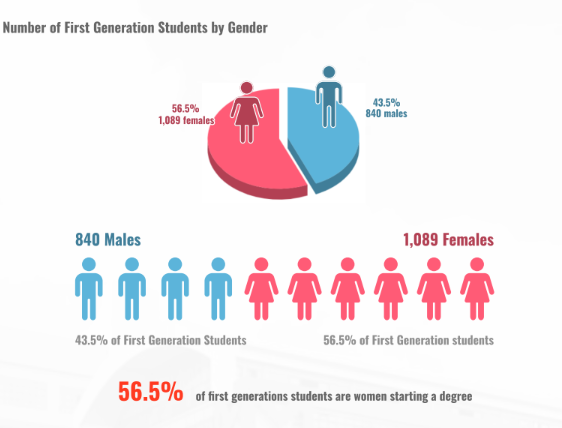
The data compiled in the University of Baguio SDG 5 Report for 2025 demonstrates sustained female leadership in tertiary enrollment and degree commencement. Women constitute 60.7% of overall enrolled students, 56.8% of new degree starters, and 56.5% of first-generation degree seekers. These metrics demonstrate that female students maintain robust access across both general university programs and specialized first-generation entry pathways.