Written by Dr. Donnavila Marie P. Herbster
NOVEMBER 19, 2026

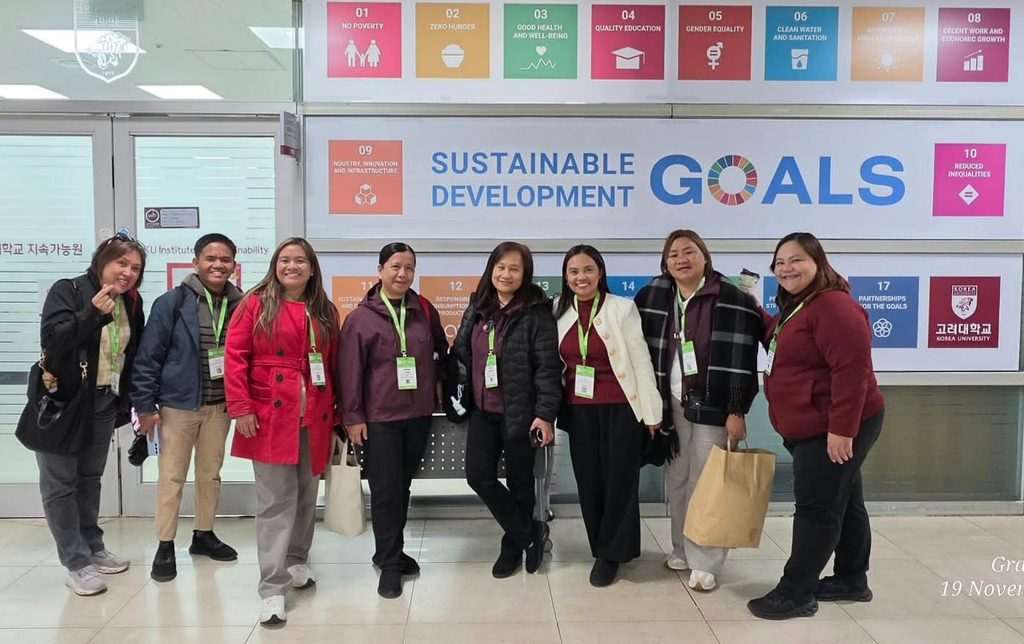
Nine members of the University of Baguio (UB) management represented the University at the Times Higher Education ( T.H.E. ) Innovation & Impact Summit 2026, held on 17–19 November 2026 at Korea University in Seoul, South Korea, advancing UB’s commitment to SDG 4 (Quality Education), SDG 9 (Industry, Innovation and Infrastructure), SDG 8 (Decent Work and Economic Growth) and SDG 17 (Partnerships for the Goals).
The delegation achieved the three objectives set by the RIECOS Office: strategic benchmarking and networking with top research universities from more than 200 institutions and organizations; faculty leadership, bringing home practical insights to help faculty become more proactive researchers and innovators; and stronger standing in accreditation and rankings, since SDG-aligned research and innovation support UB’s bid for CHED autonomous status and Centers of Excellence, its local accreditation, and its performance in the THE Impact Rankings and QS. Each delegate qualified by submitting a Capsule Research Proposal aligned with the SDG research areas of JMC No. 04, s. 2024, and committed to publishing the completed study in a Scopus-indexed journal.
Organized by Times Higher Education, the summit gathered more than 300 attendees and over 80 speakers to tackle one question: how can universities turn excellent research into impact people can see in the economy and in society? Across sixteen sessions, leaders from UC Berkeley, Korea University, National Taiwan University, Ewha Womans University, Jeonbuk National University, Singapore Management University, Elsevier, Uniseed and other institutions discussed technology transfer, start-ups and spinouts, university to industry to government collaboration, funding for early-stage innovation, the future of the PhD, and the role of artificial intelligence in higher education.
A recurring theme was the gap between a promising laboratory result and a solution that works at scale. Speakers agreed that research excellence is necessary but no longer enough: universities must also show how discoveries become technologies, enterprises, policies and better lives. After the summit, the delegates shared their key takeaways with the RIECOS Office. Several themes stood out: Innovation thrives in a connected ecosystem (SDG 17). Dr. Charesma Grace K. Lud-ayen (SCJPS) observed that innovation “does not happen in isolation” but grows when universities, government, industry, communities and funders work together. For UB, this means linking research, instruction, extension, internationalization and industry engagement under one strategic direction.
Measure real impact, not just activity (SDG 9). Vice President for Academic Affairs Dr. Janice Kaylyn K. Lonogan (OVPAA) highlighted the need to prioritize, match ambition to capacity, and “prove value through credible outcomes, not activity counts.” Dr. Medardo F. Abarientos (ARC) recommended adding downstream indicators such as spinout survival, industry co-investment, graduate employability, and measurable SDG contributions to traditional academic metrics.
Research should serve communities, starting at home. Delegates stressed anchoring innovation in the needs of Baguio City and the Cordillera Administrative Region. Dr. Kareen B. Leon (QAO) summed up the challenge as producing “more useful researches, with real and sustainable community impact.”
Entrepreneurship and start-ups need support (SDG 8). Ms. Leny O. Estacio (CCSD) noted that student start-ups need experienced mentors who can guide them end to end, and should respond to what society needs. Dr. Ellen M. Halover (SIT) proposed multi-sector “reverse pitching,” where industry, government and communities present real problems for students and faculty to solve. Human-centered, responsible AI in education (SDG 4).
Dr. Beverly B. Laltoog (OSA) emphasized AI that enhances, rather than replaces, critical thinking and creativity, alongside Green AI practices that reduce the digital carbon footprint. Delegates also recognized the call to train students not only in how to use AI, but in when to step back from it.
Moving forward
As one summit speaker reminded participants, the greatest measure of a university is how it helps others to “fly.” Through this participation, UB affirms that its pursuit of excellence is measured not only by rankings and research outputs, but by the meaningful difference its knowledge makes in the lives of its students, partners, and communities in the Cordillera and beyond. The RIECOS Office will work with the delegates to translate these insights into concrete programs, and to see their SDG-aligned research through to publication.