
Written by Mr. Justin Joseph T. Almarvez
The University of Baguio, represented by Dr. Charesma Grace K. Lud-ayen, Dean of the School of Criminal Justice and Public Safety, and Mr. Justin Joseph T. Almarvez, SCJPS faculty member, participated in the Launching and Signing of Commitment of the Consortium on Peace, Justice, and Security and the Research-to-Impact Sharing Network learning program on September 15, 2026, at PLR 4, University of the Cordilleras.
The engagement aimed to: (1) formalize interinstitutional collaboration in peace, justice, and security; (2) strengthen the capacity of educators and researchers to design credible, impact-oriented studies; and (3) translate research evidence into responsive academic programs, professional practice, public policy, and community initiatives.

The official program presents the September 15, 2026 launching and signing of commitment of the Consortium on Peace, Justice, and Security at PLR 4, University of the Cordilleras. Image courtesy of the event organizers.
Collaboration for Peace, Justice, and Security
The consortium brought together six member institutions identified in the official program, creating a shared platform for cooperation in research, education, and initiatives related to peace, justice, and public security. The morning program included welcome remarks, the introduction of the Research-to-Impact Sharing Network, a program presentation, statements of commitment, the formal signing, and a photo opportunity.
During the engagement, Dr. Lud-ayen emphasized that the national backlash and criticism confronting the criminology profession should not hinder educators, practitioners, and future professionals. She underscored that the appropriate response is to examine legitimate concerns, uphold professional standards, and innovate so that criminology remains credible, responsive, and relevant in a rapidly changing career world.
She further stressed that criminology education must keep pace with emerging fields and public-safety needs. Beyond traditional career pathways, learners should be prepared for work involving cybercrime, digital investigation, intelligence, security management, corrections, disaster response, peacebuilding, policy research, community-based crime prevention, and other evidence-driven areas that require ethical judgment and adaptable professional skills.
Dr. Charesma Grace K. Lud-ayen signs the consortium’s statement of commitment with representatives of participating institutions on September 15, 2026, at the University of the Cordilleras. Photo courtesy of the UB SCJPS Delegation.

The signing affirmed the members’ intent to share expertise, strengthen research networks, and support programs capable of producing practical benefits for institutions and communities. For UB SCJPS, the partnership opens opportunities for collaborative studies, faculty development, research mentoring, joint learning activities, and the wider dissemination and application of evidence in the criminal justice and public-safety sectors. Mr. Almarvez joined the proceedings as the SCJPS faculty representative and participated in the research-capacity-building sessions that followed. His participation supported the School’s continuing effort to connect classroom instruction and faculty inquiry with the changing competency requirements of the profession and with the needs of stakeholders in the Cordillera region and beyond.

UB SCJPS representatives join fellow consortium members following the launching and signing of commitment for peace, justice, and security. The signed undertaking provides a foundation for sustained institutional cooperation. Photo courtesy of the UB SCJPS Delegation.
The partnership also reinforces the view that professional relevance is sustained through visible competence, ethical practice, continuing development, and research that responds to real problems. Collaboration enables institutions to pool knowledge and demonstrate that criminology and public-safety education can contribute constructively to safer, fairer, and more resilient communities.
Campaigning Peace, Justice, and Security through Research Valorization
Following the signing ceremony, participants attended the Pathways to Research Valorization Learning Session Series titled Designing Research for Impact. The day-long program featured lectures by Dr. Nica D. Togana and Dr. Ferdinand D. Lawan, an open forum and synthesis, and a special online talk by Dr. Noel Klima. The sessions challenged researchers to move beyond producing reports and publications by planning how evidence can lead to improved decisions, services, policies, and measurable social change. Research valorization was presented as a process of making knowledge useful, accessible, and capable of informing action among professional, institutional, and community stakeholders.
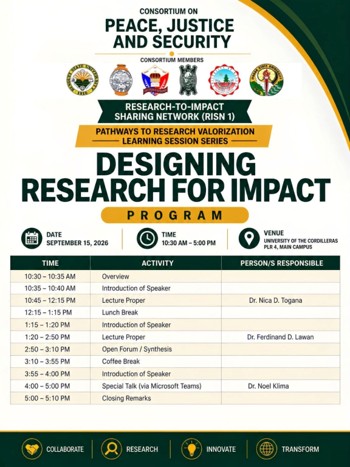
The official program for Designing Research for Impact outlines the Research-to-Impact Sharing Network learning sessions held on September 15, 2026, at the University of the Cordilleras. Image courtesy of the event organizers.
For University of Baguio, this approach is especially important because claims concerning crime prevention, rehabilitation, policing, security, and community safety carry direct consequences for people and institutions. Research therefore needs sound design, proportionate conclusions, and clear pathways from evidence to responsible application.
The learning discussions emphasized the sequence required for credible evidence: a focused research question, an appropriate population or source, relevant data, a suitable instrument, a defensible procedure, careful analysis, and a conclusion that remains consistent with the evidence. This sequence helps researchers determine whether a study can genuinely answer the question it set out to investigate.
Participants were likewise reminded not to elevate a claim beyond what the evidence can support. An activity does not automatically establish effectiveness, and an observed effect does not by itself prove sustainable impact. Stronger claims require stronger and additional evidence, including meaningful change, plausible attribution, responsible implementation, and sustained results at the population or system level.
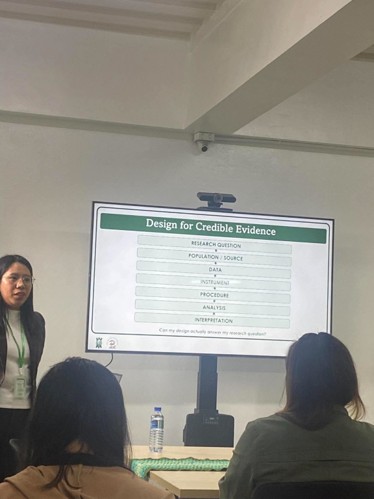
A resource speaker guides participants through the Design for Credible Evidence framework, linking the research question with data sources, instruments, procedures, analysis, and interpretation. Photo courtesy of the UB SCJPS Delegation.
These principles give criminology educators a practical basis for strengthening student research, evaluating extension programs, and documenting whether proposed interventions produce the outcomes they claim. They also encourage faculty members to communicate findings carefully and to identify the additional evidence needed before recommending broader adoption.
Achieving Peace, Justice, and Security through Sustainable Development Goals
The engagement directly supports:
- Sustainable Development Goal 4 on Quality Education by strengthening professional learning and research competence;
- SDG 9 on Industry, Innovation and Infrastructure by advancing research and innovation capacity;
- SDG 16 on Peace, Justice and Strong Institutions by promoting evidence-based and accountable approaches to justice and security; and
- SDG 17 on Partnerships for the Goals by formalizing collaboration among higher education institutions.
Its measurable outputs included the participation of two University of Baguio representatives, one signed institutional commitment, one structured research-to-impact learning program, and three scheduled expert inputs. These outputs provide traceable bases for subsequent faculty sharing, curriculum enrichment, research mentoring, proposal development, and collaborative activities under the consortium.

A resource speaker explains that stronger claims require additional evidence and that sustainable impact must be demonstrated at the population or system level. Photo courtesy of the UB SCJPS Delegation.
The activity aligns with the University of Baguio’s Vision of providing balanced quality education that nurtures academic excellence, relevant social skills, and ethical values, and with its Mission of educating individuals to become empowered professionals in a global community. It also advances the University’s objectives of undertaking scientific and significant research, advocating sustainable programs for communities and the environment, mastering relevant skills, and demonstrating exemplary performance in one’s field of specialization.
Through the values of competence, integrity, and service, University of Baguio affirms that the profession can respond constructively to public scrutiny. In a fast-paced career environment, relevance will be sustained by ethical leadership, evidence-based teaching, responsible innovation, expanded professional pathways, and partnerships that turn research into meaningful action.