
Written by Cherrie Almazan
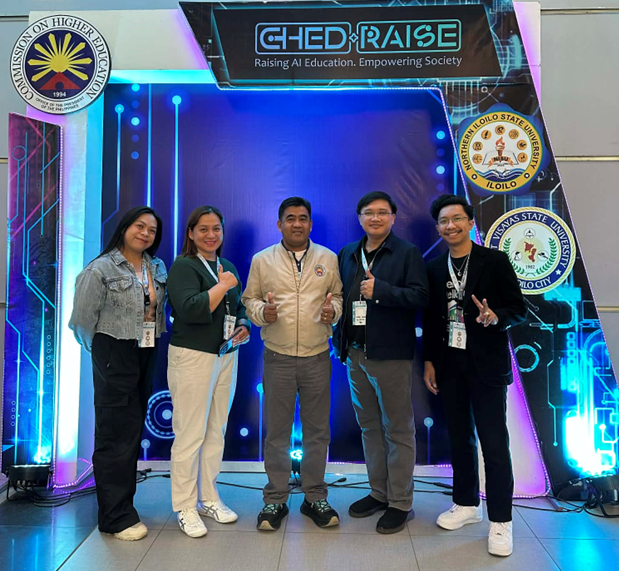
The School of Information Technology of the University of Baguio participated in CHED RAISE 2026 (Raising AI Education. Empowering Society), a three-day national convention centered on the integration of Artificial Intelligence (AI) in Philippine higher education.
Conducted from February 25–27, 2026, at the Iloilo Convention Center, the convention was organized by the Commission on Higher Education (CHED) in collaboration with West Visayas State University and Northern Iloilo State University. The event was presided over by CHED Chairperson Shirley C. Agrupis, together with CHED Commissioners and officials.
The convention convened representatives from higher education institutions, government agencies, and industry sectors nationwide, including Jose Francisco B. Benitez of the Technical Education and Skills Development Authority (TESDA) and Ronald U. Mendoza of the Department of Education (DepEd). University presidents, deans, program heads, faculty members, and students also participated, reflecting a multi-sectoral approach to AI development in the Philippines.
The National AI Upskilling Roadmap
A central component of the convention was the presentation of the National AI Upskilling Roadmap, a coordinated initiative of CHED, TESDA, and DepEd. The roadmap emerged from a June 2025 recommendation of the Private Sector Advisory Council (PSAC), which proposed the establishment of a government- and private sector-led framework aimed at preparing Filipinos for AI-enabled transformation. The initiative subsequently received approval from the Office of the President.
The roadmap is anchored on the Philippine Skills Framework for Analytics & AI, ensuring standardized competencies and consistent learning outcomes across institutions and training providers. National AI reports indicate that while the Philippines demonstrates high levels of AI utilization, the country remains predominantly dependent on foreign-developed systems. The roadmap therefore articulates a strategic national direction toward developing local AI capabilities and fostering innovation within the domestic ecosystem.
Faculty Breakout Session: Microcredentials and Institutional Readiness
On the first day of the convention, participants were divided into breakout sessions for students, faculty, and administrators.
During the faculty session, discussions centered on foundational AI concepts, institutional upskilling strategies, and programmatic implementation. Two universities presented their respective AI microcredential offerings, demonstrating flexible and stackable approaches to competency development in artificial intelligence.
Representatives from IBM provided insights into the infrastructural requirements necessary for the establishment of AI programs, including computational resources, data governance systems, and faculty capacity-building mechanisms. The session emphasized that effective AI integration necessitates both curricular innovation and institutional readiness.
Curriculum Reforms: Upcoming CHED Memorandum Order (CMO)
On the second day, participation in the administrators’ breakout session provided insights into policy and curriculum reforms affecting Computer Science (CS), Information Technology (IT), and Information Systems (IS) programs.
It was announced that a revised CHED Memorandum Order (CMO) for these computing programs is forthcoming. Notable developments include:
- An increase in professional electives from 12 units to 21 units
- Greater emphasis on Artificial Intelligence and emerging technologies
- Stronger alignment with industry requirements
- A framework described as responsive to evolving technological demands
The expansion of professional electives offers institutions greater flexibility in structuring specialization tracks, particularly in AI-related domains.
Research Orientation: AI and Industry-Aligned Innovation
In addition to curricular revisions, the convention highlighted research priorities in higher education. While research initiatives remain aligned with the Sustainable Development Goals (SDGs), institutions are encouraged to incorporate AI-focused inquiry and industry-aligned innovation within their research agendas.
This orientation positions artificial intelligence not only as an instructional domain but also as a catalyst for applied research and technological development.
Institutional Continuity and Future Engagement
The final half-day of the convention synthesized key discussions and strategic directions. It was formally announced that CHED RAISE will become an annual national convention, institutionalizing continued dialogue and collaboration among higher education institutions, government agencies, and industry stakeholders in advancing AI integration within Philippine higher education.
Sustainable Development Support
The participation of the University of Baguio in CHED RAISE 2026 supports several United Nations Sustainable Development Goals (SDGs), particularly SDG 4: Quality Education, SDG 9: Industry, Innovation and Infrastructure, SDG 8: Decent Work and Economic Growth, and SDG 17: Partnerships for the Goals.
The convention emphasized the integration of artificial intelligence in higher education through faculty upskilling, curriculum enhancement, and the development of microcredentials, contributing to the advancement of inclusive and future-ready education. The focus on AI infrastructure, research development, and industry-aligned innovation also promotes technological advancement and strengthens the role of higher education institutions in fostering innovation. Moreover, the National AI Upskilling Roadmap supports the preparation of learners and professionals for emerging workforce demands, contributing to economic development in an increasingly AI-driven landscape.
Finally, the collaboration among higher education institutions, government agencies such as CHED, TESDA, and DepEd, and industry partners reflects the importance of multi-sector partnerships in advancing national educational and technological initiatives.