
Written by Angel Mae R. Aboy and Jhayzel A. Delposo
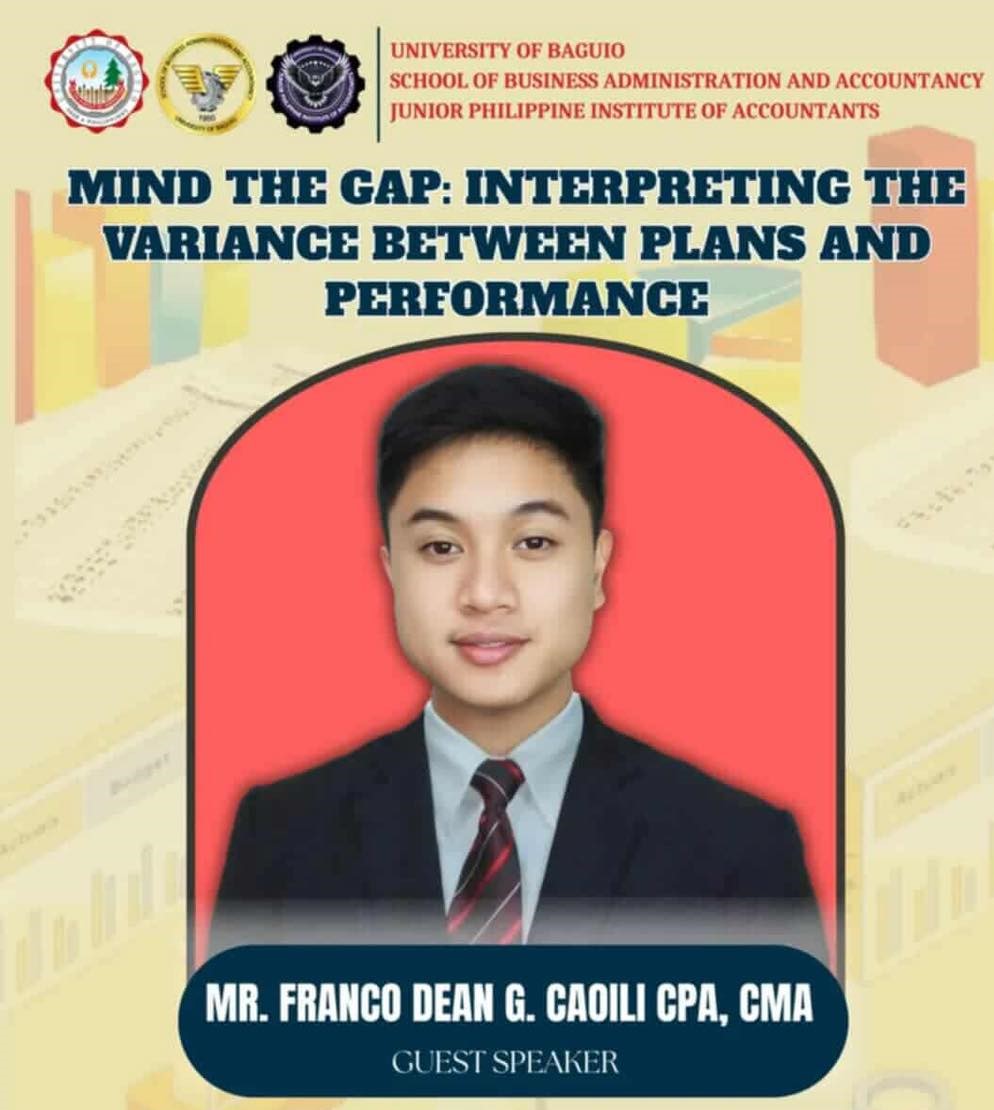
In pursuit of strengthening analytical competence and preparing students for managerial decision-making, the 4th Year Accountancy students undergoing their On-the-Job Training (OJT), in collaboration with the University of Baguio Junior Philippine Institute of Accountants (UBJPIA), organized a webinar titled “Mind the Gap: Interpreting the Variance Between Plans and Performance” on November 15, 2025, held via Google Meet. The activity was designed to enhance students’ grasp of variance analysis as a vital tool for evaluating organizational performance. By offering both conceptual foundations and practical illustrations, the webinar aimed to strengthen students’ academic preparation and build confidence in applying analytical frameworks used in professional practice. Before the session, a short pre-assessment was administered to gauge participants’ baseline knowledge and tailor the discussion to their needs.
The session featured Mr. Franco Dean G. Caoili, who delivered an extensive discussion on identifying, interpreting, and managing variances within organizational settings. Thirty-nine participants from diverse programs including Accountancy, Financial Management, Education, Entrepreneurship, Political Science, Computer Science, Information Technology, Industrial Arts, and Public Resource Management attended the webinar.
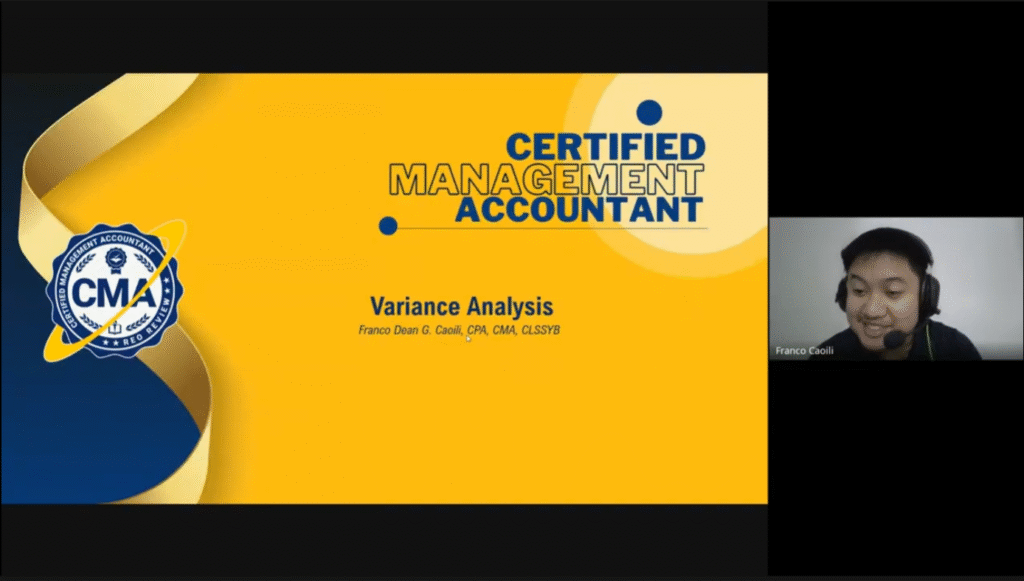
Mr. Caoili presented a comprehensive session on strategy, budgeting, standard-setting and variance analysis, emphasizing standards and variances as management tools for performance evaluation and decision-making. He blended technical accounting concepts with practical examples and managerial insights to show how strategy, budgeting and standards align to guide organizational performance: strategy converts goals into tactics and must be communicated from leadership to frontline, while budgets, built from standards set through activity analysis, historical data, benchmarking and target costing, serve both as control mechanisms and communication tools. He explained different standard types (ideal, practical, normal, lax) and advised selecting costing systems (actual, normal, standard) based on traceability and organizational needs.
Variance analysis, which compares plan versus actual, was framed as a way to measure price/rate and quantity/usage variances across direct materials, labor, and overhead, including spending and capacity/volume variances, with clear computation methods and journal treatments; for multiple inputs or products, he demonstrated how mix and yield variances decompose total usage variance. He closed by stressing that variances are diagnostic signals that require investigation, distinguishing recurring from one-off issues, and recommended using them to drive data-informed decisions, typically via monthly reviews or more frequent or daily monitoring when dashboards and automation are available.
During the Q&A segment, Mr. Caoili engaged directly with participant queries, using the questions to move beyond formulas and explain how to interpret and act on variances: he urged treating variances as diagnostic signals that must be investigated for root causes, recommended checking recurrence across periods, examining operational context (e.g., one-off client demands vs process issues), assessing magnitude and impact, and combining quantitative variance data with qualitative facts and dashboards before deciding corrective action; he also advised more frequent monitoring for high priority goals so patterns are detected early.
A highlighted question was “How can leaders distinguish between a manageable variance and one that signals a deeper systemic issue?” Mr. Caoili replied that leaders should determine whether the variance is isolated or recurring, investigate causes (client demands, staffing, process gaps, turnover), evaluate its financial and operational impact, and only then decide whether tactical fixes or broader systemic changes are needed, using dashboards and trend analysis to support the decision.
The webinar likewise reflected the University of Baguio’s commitment to the United Nations Sustainable Development Goals (SDGs) by integrating sustainable and socially responsive learning outcomes into its academic activities. The activity promoted SDG 4 (Quality Education) by delivering an accessible, high-quality learning experience facilitated by an expert resource speaker that strengthened students’ conceptual understanding and analytical proficiency in variance analysis.
It also contributed to SDG 8 (Decent Work and Economic Growth) by equipping participants with competencies relevant to future professional roles in finance, accounting, management, and public administration, particularly skills in financial evaluation, performance monitoring, and managerial decision-making. Furthermore, the discussion emphasized the importance of data-driven evaluation and efficient organizational systems, thereby aligning with SDG 9 (Industry, Innovation, and Infrastructure) through the promotion of informed, evidence-based approaches that support more efficient and innovative organizational systems.
The organizers thank Mr. Caoili for his valuable contribution and all participants for their active engagement. Certificates of participation will be issued to attendees who complete the post-event assessment and evaluation forms.