
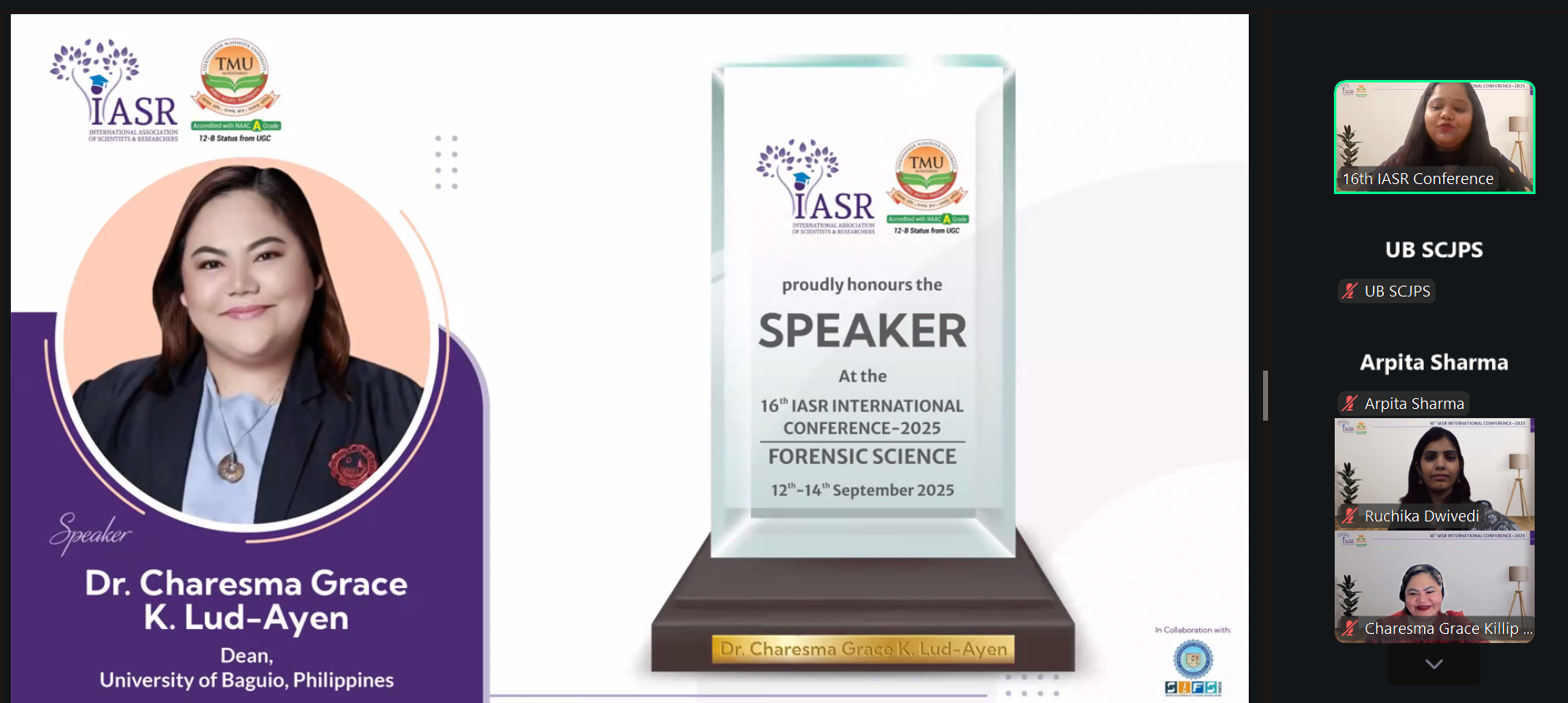
Moradabad, India — At the 16th International Association of Scientists & Researchers (IASR) International Conference on Forensic Science, held from September 12-14, 2025, Dr. Charesma Grace K. Lud-ayen, Dean of the University of Baguio’s School of Criminal Justice and Public Safety, delivered a keynote address that challenged traditional forensic approaches and redefined the role of investigators. The conference, a three-day program organized in collaboration with Teerthanker Mahaveer University (TMU), aimed to share contemporary advancements in forensic science with professionals, researchers, and students to boost their knowledge and morale. Dr. Lud-ayen’s presence was a great addition to the forum, with her views offering an invaluable contribution to the learners.
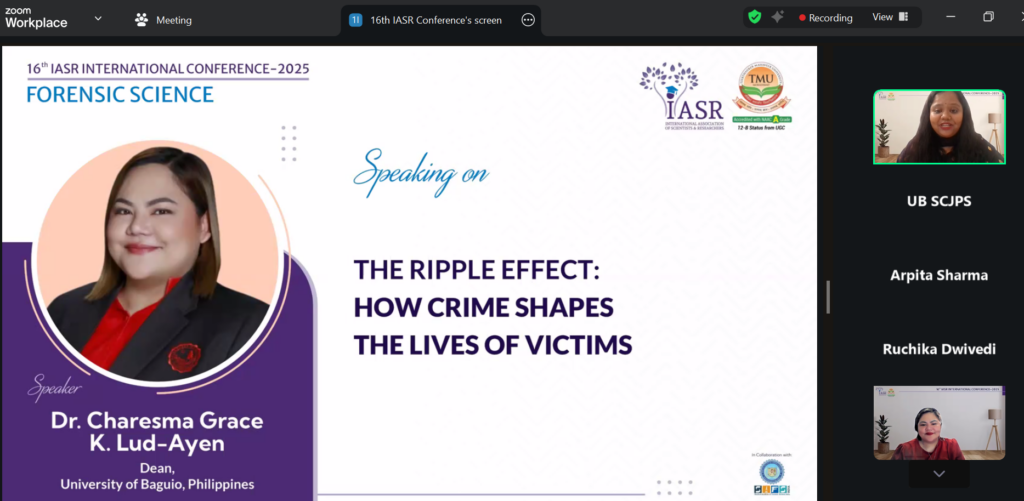
At the 16th International Association of Scientists & Researchers (IASR) International Conference on Forensic Science, Dr. Charesma Grace K. Lud-ayen, Dean of the University of Baguio’s School of Criminal Justice and Public Safety, delivered a keynote address that challenged traditional forensic approaches and redefined the role of investigators. Her talk, titled “The Ripple Effect: How Crime Shapes the Lives of Victims,” provided a raw and powerful glimpse into the enduring trauma of sexual assault survivors, advocating for a more holistic, compassionate, and interdisciplinary approach to justice.
Re-examining Misconceptions and Redefining the Crime Scene, Dr. Lud-ayen began by dismantling common misconceptions about sexual violence. Contrary to popular belief, a significant majority of sexual assault cases (70-71%) are perpetrated by individuals known to the victim, often within their own homes, which subverts the idea of a home as a safe haven. This relational proximity and betrayal of trust, particularly from family members such as biological fathers, cousins, and distant relatives, adds a profound layer of psychological pain to the physical trauma. The victim’s body itself becomes a “living repository of the crime’s history” and a “nexus of physical and psychological evidence”.
Dr. Lud-ayen’s address connected her findings to the Sustainable Development Goals (SDGs). She explained how a forensic approach can promote wider societal change.
To prevent sexual violence, education policy must be a central element of prevention. This involves educating parents and children on abuse prevention and safety. Inclusive education is also vital for addressing these sensitive topics in a supportive way. Academic institutions need to develop pedagogy and curriculum on sustainable development to foster empathy and respect. This includes efforts across all levels, from early childhood education to lifelong learning, including adult education and community learning initiatives.
Rape is a crime of domination that disproportionately affects women and children. Achieving gender equality and combating gender-based violence requires shifting social attitudes and rejecting the cultural shame that prevents survivors from seeking help. Women’s empowerment and support programs are crucial for survivors to move from despondency to resilience.
Dr. Lud-ayen emphasized the need for a humane and effective justice system. Survivors often face challenges like delayed reporting due to fear and a lack of family support, as well as re-victimization by insensitive police and medical professionals. To build strong institutions, it’s essential to implement good governance, which falls under SDG No. 16: Peace, Justice, and Strong Institutions. Sexual violence is also a widespread societal problem that requires international collaboration on SDGs and cross-sectoral dialogue, allowing UB to pursue SDG No. 5: Gender Equality. She called for partnerships with NGOs/governments for SDG policy, highlighting the important role of shelters and NGOs in providing psycho-social support and reinforcing the university’s dedication to SDG No. 17: Partnerships for the Goals. Her insights offer a path for developing best practices and empower forensic scientists to become agents of social change.