
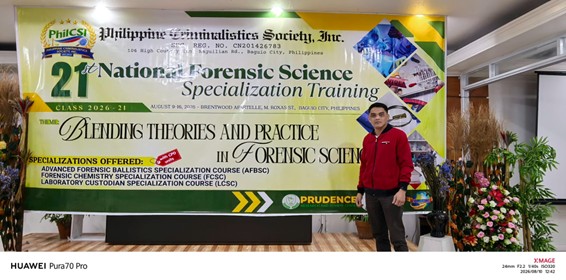
Mr. Immanuel Jesus A. Fernandez, a faculty member of the University of Baguio School of Criminal Justice and Public Safety (UB-SCJPS), participated in the 21st National Forensic Science Specialization Training of the Philippine Criminalistics Society, Inc. (PhilCSI), held from August 9 to 16, 2026, at Brentwood Apartelle along M. Roxas Street in Baguio City.
Carrying the theme “Blending Theories and Practice in Forensic Science,” the training brought together scientific concepts and practical exercises in Advanced Forensic Ballistics, Forensic Chemistry, and Laboratory Custodianship. These areas represent important components of forensic work, from the examination of physical evidence to the proper handling and safeguarding of materials entrusted to forensic laboratories.
The activity directly supports Sustainable Development Goal 4 (SDG 4): Quality Education, particularly its emphasis on relevant knowledge, skills, and lifelong learning. By engaging in specialized professional training, Fernandez strengthens his own technical knowledge and teaching practice, helping ensure that classroom instruction remains connected to current professional applications in forensic science. Faculty development of this kind contributes to an educational environment where students are exposed not only to theoretical concepts but also to the practical standards and considerations that characterize forensic and investigative work.
One of the documented activities placed Fernandez at a laboratory microscope, wearing appropriate protective equipment while examining material under magnification. The exercise demonstrates the careful observation and methodical approach required in forensic examination. Findings become meaningful when an examiner can accurately describe observations, recognize the limitations of a particular method, and maintain clear identification and handling of the specimen throughout the examination process.
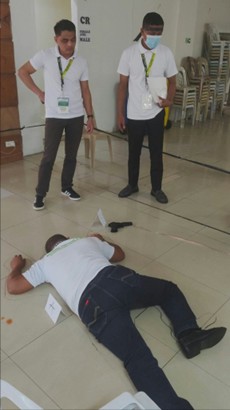
Another photograph shows Fernandez and fellow participants engaged in a simulated crime-scene exercise. Evidence markers and a mock firearm are visible near a person portraying a casualty. The simulation allows participants to consider the proper sequence of investigative actions—from observing and assessing the scene before disturbing potential evidence, to recognizing relevant items, documenting their location, and coordinating with other personnel involved in the process.
These practical experiences further reinforce SDG 4 by strengthening experiential and practice-oriented learning. For criminal justice educators, professional exposure to actual training scenarios can provide concrete reference points for classroom discussions, demonstrations, case analysis, and skills development. Students may learn the concepts of evidence preservation, laboratory examination, documentation, and custodianship through textbooks and lectures; however, faculty members who continuously engage in professional learning can help contextualize these concepts within the sequence and discipline required in forensic practice.
The training also contributes to SDG 16: Peace, Justice and Strong Institutions, which promotes peaceful and inclusive societies, access to justice, and effective, accountable institutions. Although the activity was conducted as a professional training rather than an actual criminal investigation, its emphasis on scientific examination, accurate documentation, evidence integrity, and responsible handling of forensic materials reflects practices that support reliable investigative and justice processes. Proper forensic work can help ensure that conclusions are grounded in documented observations and scientifically appropriate procedures rather than unsupported assumptions.
The emphasis on laboratory custodianship is particularly relevant to this objective. Maintaining the identity, condition, documentation, and security of materials throughout their handling is an important part of preserving the reliability and integrity of forensic examination. These principles can likewise be introduced to students as part of their preparation for future responsibilities in criminal investigation, law enforcement, forensic science, and other criminal justice professions.
The participation also reflects the value of professional and institutional knowledge exchange, consistent with the spirit of SDG 17: Partnerships for the Goals. Engagement with a national professional organization such as PhilCSI provides opportunities for educators and practitioners to share knowledge, encounter specialized practices, and remain connected to developments within the forensic science community. Such professional engagement can help bridge academic instruction and the evolving needs of the criminal justice sector.
For Fernandez, the training represents more than an opportunity to acquire additional technical knowledge. It strengthens the connection between professional development, quality education, and justice-oriented practice. The experience can be translated into classroom learning that helps students understand not only what forensic procedures are, but also why careful observation, documentation, evidence preservation, scientific reasoning, and professional responsibility matter.
Through continuous faculty development and the integration of relevant professional experiences into instruction, UB-SCJPS contributes to SDG 4 by advancing quality, relevant, and practice-oriented education, while supporting the broader objectives of SDG 16 in promoting reliable and accountable justice processes and the knowledge-sharing dimension of SDG 17.
From the classroom to the simulated crime scene, the experience underscores a fundamental principle of criminal justice education: quality learning is strengthened when sound theory is connected with responsible practice.