
The University of Baguio (UB) operates with an institutional mechanism for workforce representation through the University of Baguio Faculty and Education Workers Union (UBFEWU). This structure ensures faculty and staff have a democratically elected voice in internal matters, supporting the principles of SDG 16: Peace, Justice, and Strong Institutions, which emphasize transparent and accountable governance.
The UBFEWU’s Constitution and By-Laws establish a democratic process for selecting its leaders, ensuring representatives are accountable to the general membership. The Executive Committee serves as the Union’s primary governing body. Its key officers—including the President, Vice-President, Secretary, Treasurer, Auditor, and the Chairman of the Board of Directors—are elected through secret ballot by the general assembly. These officers serve a five-year term, ensuring continuity of leadership and sustained representation. The Union also maintains a representative Board of Directors composed of at least fifteen (15) sectoral directors, each elected by secret ballot within their respective colleges and departments. The Chairman of the Board of Directors, also an elected representative, automatically sits as a member of the Executive Committee, serving as the Chief Liaison Officer between the Board and the ExCom.
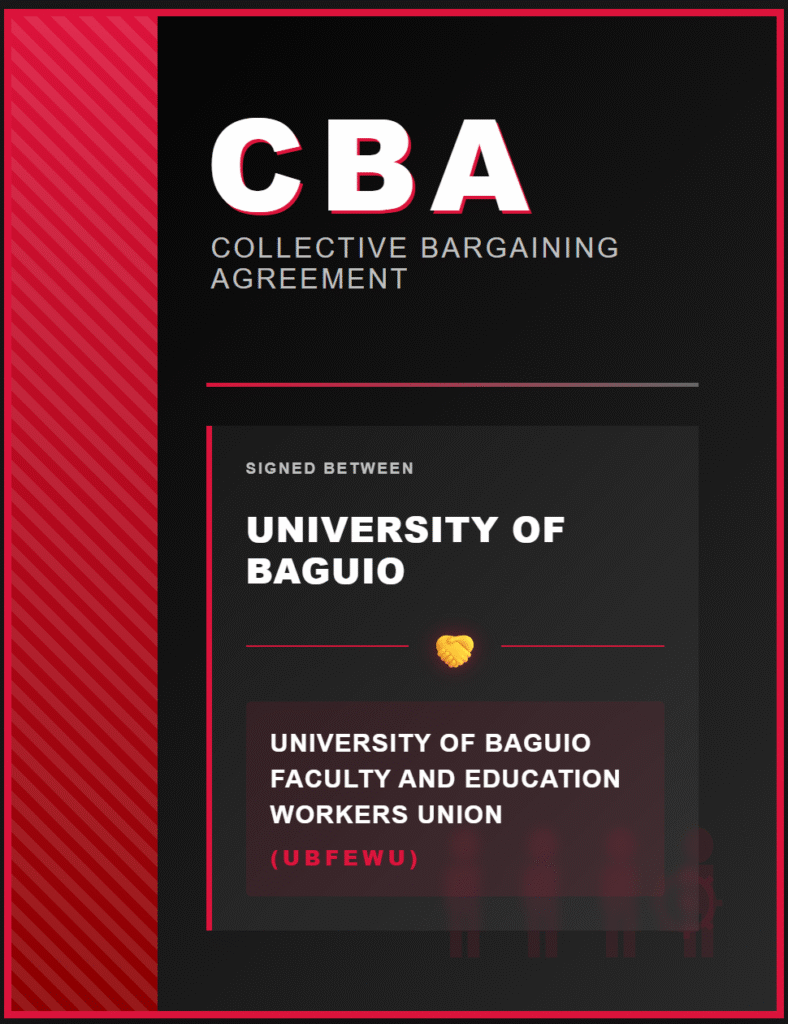
This elected structure provides a strong mechanism for genuine employee representation and upholds principles of SDG 10: Reduced Inequalities by ensuring that all voices—from academic to non-academic sectors—are included and valued. This representation is formally recognized in the Collective Bargaining Agreement (CBA) between the Administration and the UBFEWU.
The Administration explicitly recognizes the UBFEWU as the sole and exclusive bargaining REPRESENTATIVE of all academic and non-academic employees covered by the agreement. The elected officers and representatives are directly involved in collective bargaining on matters of salaries, hours of work, and other conditions of employment—aligning with SDG 8: Decent Work and Economic Growth, which advocates for fair labor conditions, employee welfare, and productive employment.
The Panel of Negotiators for the CBA is appointed by the Executive Committee. Elected representatives also serve in the multi-step Grievance Machinery established to address disputes arising from the interpretation or application of the CBA or University policies. This system includes a Grievance Committee composed of two (2) representatives from the UNION and two (2) from the Administration, ensuring equal participation and fostering inclusive and peaceful resolution mechanisms—an important component of SDG 16.
Additionally, a Labor-Management Committee (LMC) is established to discuss matters affecting labor relations. It is composed of three (3) members from the Administration and three (3) from the UNION, creating a regular platform for dialogue, cooperation, and partnership. This aligns directly with SDG 17: Partnerships for the Goals, which highlights the importance of collaborative structures for sustainable progress.
This system of elected representation ensures that the UBFEWU is well-positioned to advocate for faculty and education workers in collective bargaining concerning salaries, benefits, and other terms of employment with the University of Baguio, Inc. Moreover, elected officers are responsible for promoting harmonious and progressive labor-management relations—supporting a fair, just, and transparent institutional environment.
By guaranteeing that key representatives are elected by the membership rather than appointed by the institution, the University of Baguio strengthens participatory governance, protects workers’ rights, and reinforces institutional legitimacy in its labor relations—upholding the spirit of the United Nations Sustainable Development Goals.