
Written by Dannieca Buyayo, Florene Naomi Ursua, Jelisa Valdez and Anna Uy
BAGUIO CITY, Philippines – The University of Baguio School of Criminal Justice and Public Safety (SCJPS) Graduate School conducted a Center of Excellence project webinar entitled “Equity in Action: Reframing the Pursuit of Justice” on March 1, 2026, via Zoom Video Communications. The activity formed part of the institution’s Center of Excellence Project, which aims to strengthen academic engagement and professional development in criminal justice and public safety by providing graduate students and practitioners with opportunities to engage in contemporary discussions on justice, law, and social responsibility.
Anchored on the theme “Prosecuting Urban Crime Through Intersectional and Culturally Sensitive Lenses,” the webinar focused on the growing need for prosecutors and justice practitioners to consider the social realities that influence crime and the administration of justice in urban communities. The discussion explored how factors such as culture, socioeconomic conditions, and gender can shape the experiences of individuals within the justice system. By highlighting these perspectives, the seminar emphasized that effective prosecution requires not only legal expertise but also an understanding of the broader social contexts that affect victims, witnesses, and accused individuals.
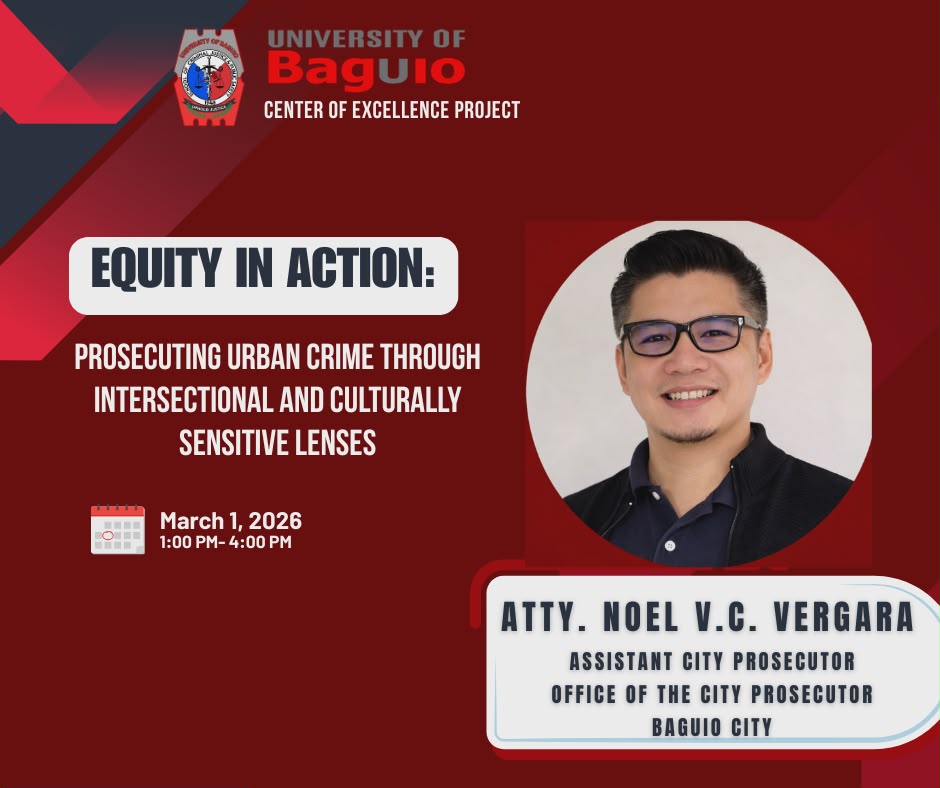
The session featured Atty. Noel V. C. Vergara, Assistant City Prosecutor from the Office of the City Prosecutor of Baguio City, as the resource speaker. Drawing from his experience in prosecution, Atty. Vergara discussed the importance of applying intersectional and culturally aware approaches in addressing crimes committed in diverse urban settings. He explained how prosecutors must balance the strict application of the law with a deeper awareness of the circumstances surrounding a case, ensuring that legal processes remain fair, impartial, and responsive to the communities they serve. Through practical examples and reflections from his professional practice, he encouraged participants to view justice not only as a legal obligation but also as a commitment to fairness, accountability, and ethical decision-making.
The discussion also highlighted how culturally sensitive prosecution can contribute to building public trust in legal institutions. Participants were encouraged to reflect on the role of justice professionals in addressing systemic challenges within society while maintaining the principles of due process and equal protection under the law. By examining real-world scenarios and engaging in dialogue with the speaker, attendees gained a deeper appreciation of how thoughtful and equitable approaches to prosecution can lead to more effective and inclusive justice outcomes.
The webinar gathered graduate students, faculty members, and professionals in the field of criminal justice and public safety, providing a platform for academic exchange and professional reflection. The activity encouraged participants to critically examine traditional perspectives on law enforcement and prosecution while considering how evolving social conditions call for more responsive and human-centered approaches to justice.