
Written by: Voughn Liam Laruan, Dannieca Buyayo, Florene Ursua, Jelisa Valdez
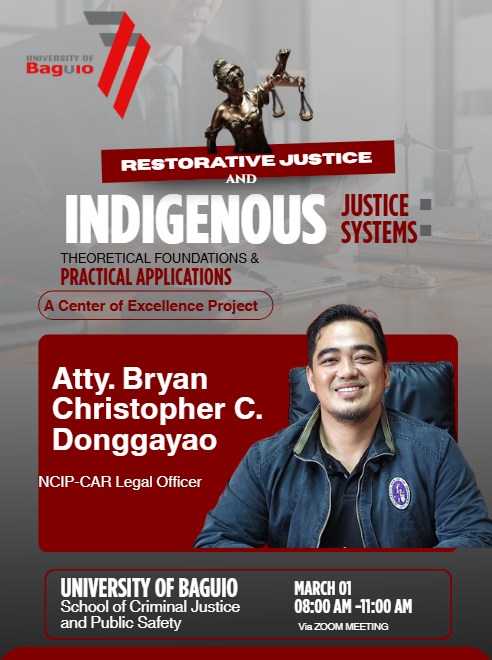
The Graduate School of the School of Criminal Justice and Public Safety (SCJPS) successfully conducted a Center of Excellence Project webinar titled “Restorative Justice and Indigenous Justice Systems: Theoretical Foundations and Practical Applications,” guided by the theme “Bridging Traditions. Advancing Justice. Empowering Communities.”
The three-hour virtual session, held from 8:00 AM to 11:00 AM, brought together students and justice practitioners for a discussion on alternative approaches to justice that emphasize cultural sensitivity and community involvement. Highlighting the importance of integrating restorative principles and indigenous justice systems into contemporary legal practices to create inclusive and responsive frameworks.
The event featured Atty. Bryan Christopher C. Donggaya, a Legal Officer of the National Commission on Indigenous Peoples – Cordillera Administrative Region (NCIP-CAR), as the resource speaker. Drawing from his professional experience, Atty. Donggaya provided the participants with a comprehensive understanding of both the theoretical foundations and practical applications of restorative justice and indigenous legal systems.
Emphasizing that justice is not solely about punishment but also about healing, reconciliation, and restoring relationships within communities. He explained that indigenous justice systems, deeply rooted in tradition and cultural values, offer effective mechanisms for conflict resolution that prioritize harmony and collective responsibility of all the people. Atty. Donggaya recognizes and respects indigenous knowledge systems within the broader legal framework, which can lead to more culturally grounded and community-centered approaches, particularly in areas where formal legal systems may fall short in addressing local realities.
Through this initiative, the SCJPS Graduate School reaffirmed its commitment to advancing academic excellence and fostering socially responsive education. By bridging traditional practices with modern justice concepts, the webinar served as a significant step toward empowering communities and promoting a more holistic and inclusive justice system.
Aligned with global development priorities, the webinar supports several Sustainable Development Goals (SDGs), particularly
- SDG 16: Peace, Justice, and Strong Institutions, by promoting inclusive justice systems, conflict resolution, and access to justice.
- SDG 10: Reduced Inequalities through the recognition and inclusion of indigenous communities in legal processes.
- SDG 4: Quality Education by enhancing knowledge and professional development among participants. Furthermore, the discussion reflects the principles of SDG 11: Sustainable Cities and Communities, as it highlights the role of community-centered justice in strengthening social cohesion and local governance.