
Written by: Dannieca Buyayo, Jelisa Valdez, Voughn Liam Laruan
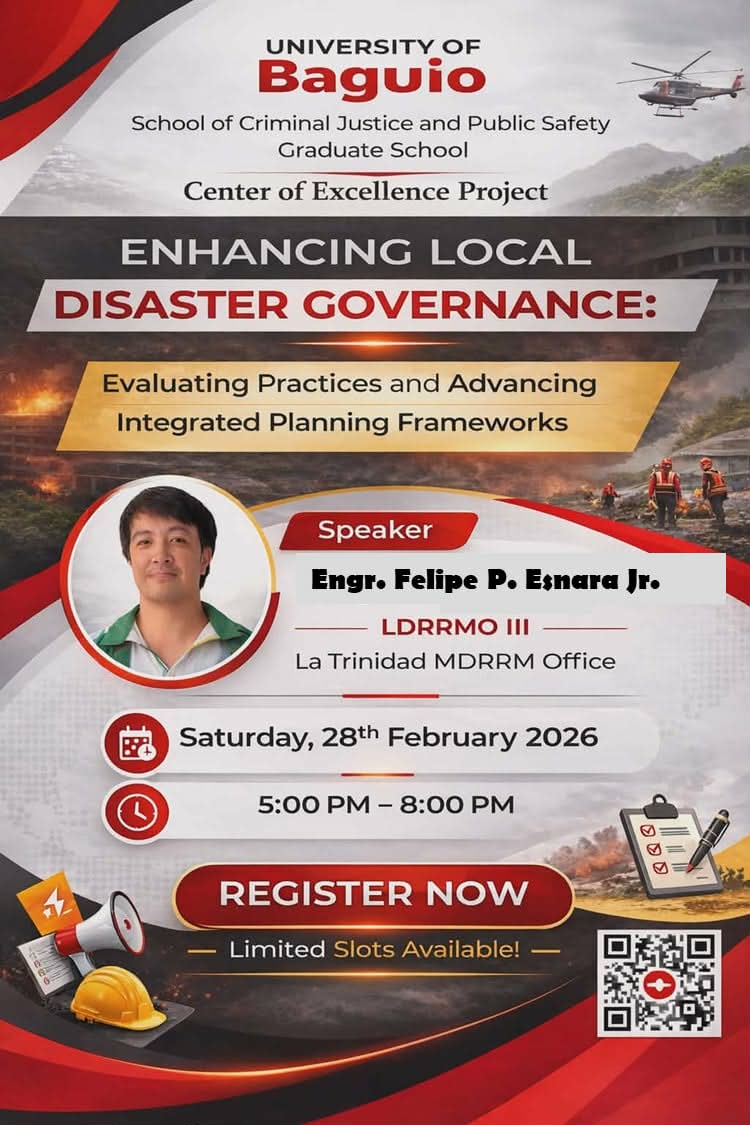
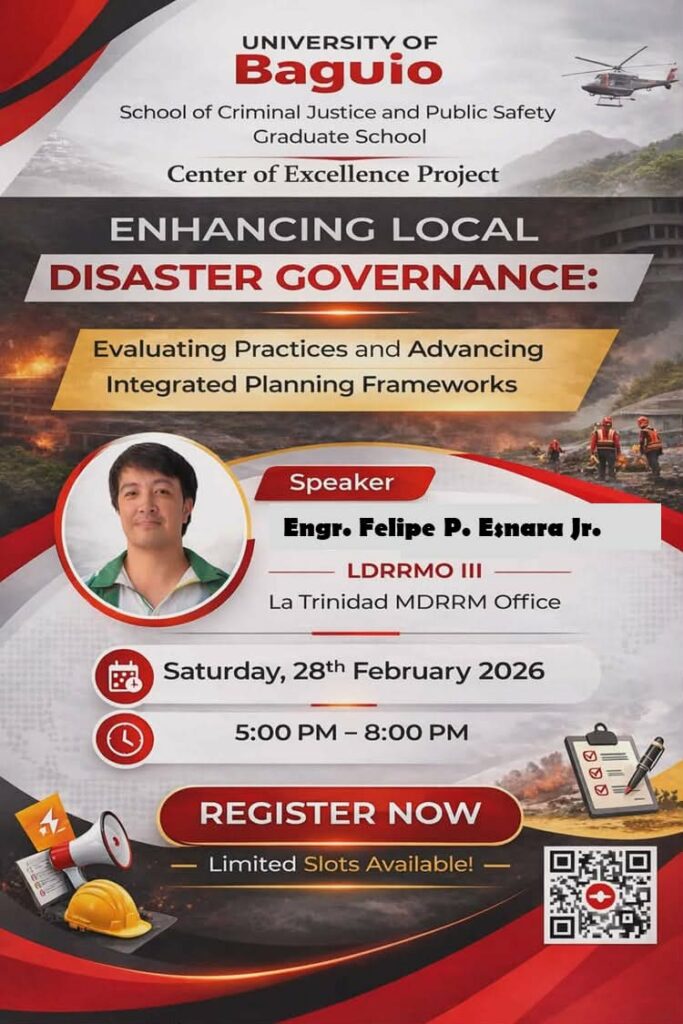
BAGUIO CITY – The University of Baguio School of Criminal Justice and Public Safety (SCJPS) Graduate School conducted a webinar titled “Enhancing Local Disaster Governance: Evaluating Practices and Advancing Integrated Planning Frameworks” on February 28, 2026, via Zoom Video Communications. The activity formed part of the institution’s Center of Excellence Project, which aims to strengthen academic engagement and professional development in criminal justice and public safety by providing graduate students, researchers, and DRRM practitioners with opportunities to participate in timely and relevant discussions on disaster risk governance, community resilience, and integrated local planning
The session featured Engr. Felipe P. Esnara Jr., Local Disaster Risk Reduction and Management Officer III (LDRRMO III) from the La Trinidad Municipal Disaster Risk Reduction and Management (MDRRM) Office, is the resource speaker. Drawing from his direct experience in local DRRM implementation, Engr. Esnara discussed the importance of evaluating existing disaster governance structures with honesty and clarity, identifying both what is working and where significant gaps remain.
His discussion examined how current DRRM practices at the local level can be evaluated more critically, and how integrated planning frameworks that align disaster preparedness with land use, climate change adaptation, and local development goals can produce more resilient communities. These are factors that weaken a community’s ability to prepare for and recover from disasters. Through practical examples from his work in La Trinidad, he encouraged participants to view disaster governance not as an isolated technical concern, but as a matter of institutional integrity, community trust, and long-term public safety.
The webinar also highlighted how integrated planning frameworks can address many of the fragmented approaches currently seen in local DRRM practice. Participants were encouraged to reflect on how disaster risk can be embedded into broader local governance decisions, from how communities are zoned and developed to how local budgets are allocated and how public services are designed. By examining real-world scenarios and engaging in dialogue with the speaker, attendees gained a deeper understanding of how thoughtful, well-coordinated approaches to disaster planning can reduce vulnerability and save lives, particularly in high-risk areas like the Cordillera Administrative Region. By highlighting these perspectives, the seminar emphasized that effective disaster governance is not simply an emergency function but a core responsibility of every local institution.
The webinar gathered graduate students, faculty members, and professionals in the fields of criminal justice, public safety, and disaster risk management, providing a platform for academic exchange and practical reflection. The activity encouraged participants to critically assess traditional DRRM approaches while considering how evolving climate conditions, rapid urbanization, and growing social inequalities are reshaping the disaster risk landscape. The three-hour session allowed for meaningful interaction between the speaker and participants, reinforcing the value of combining academic knowledge with field experience in addressing complex governance challenges.
Beyond its academic value, the webinar also reflects the University of Baguio’s commitment to contributing to the United Nations Sustainable Development Goals (SDGs). The activity supports SDG 4 Quality Education by promoting advanced and practice-informed learning that builds critical thinking and professional competence among students and practitioners. It also contributes to SDG 11 Sustainable Cities and Communities by advancing the knowledge and tools needed to build more disaster-resilient communities at the local level. Furthermore, the webinar supports SDG 13 Climate Action by integrating climate risk considerations into disaster governance planning, and SDG 16 Peace, Justice, and Strong Institutions, as the seminar reinforced the importance of capable, transparent, and accountable local institutions in protecting communities and upholding public safety.
Through initiatives such as this webinar, the UB-SCJPS Graduate School continues to foster meaningful academic dialogue and professional growth, preparing future public safety professionals and disaster risk managers to address complex governance challenges with competence, preparedness, and a genuine commitment to building safer, more resilient communities.